
Lucas-Nülle GmbH
Booth number: A04
www.lucas-nuelle.com/
About us
Lucas-Nuelle – Real Experience Learning
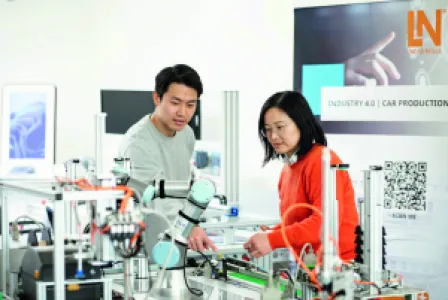
Lucas-Nuelle develops integrated training systems for technical education and workforce development. At the core of our approach is Real Experience Learning – a didactic concept that combines real hardware, structured learning processes and the digital learning environment RXLea. This enables learners to go beyond theoretical knowledge and develop lasting practical competence through hands-on experience, application and reflection.
Our solutions cover the four key technology domains: Mobility, Energy, Building and Industry. They support vocational schools, universities, training centres and industrial organizations in preparing skilled professionals for the demands of a rapidly evolving world of work – from technical fundamentals to complex, interconnected applications.
From individual training systems and complete laboratory equipment to turnkey training centres, Lucas-Nuelle combines didactics, real technologies and digital learning support into integrated education solutions. Since 1979, customers in more than 95 countries have trusted Lucas-Nuelle to deliver practice-oriented technical education and prepare the skilled workforce of tomorrow.

Address
No. 7J, Lane 129, Huajiang Rd.
(Shanghai Lucas Education Technology Ltd.)
201803 Shanghai
China
E-mail: info@lucas-nuelle.de
Phone: +65 88696875
Internet: www.lucas-nuelle.com/
Contact person:
Products & Services
Lucas-Nuelle – Real Experience Learning for Technical Education
Lucas-Nuelle develops integrated training solutions that turn complex technologies into practical skills. Our approach, Real Experience Learning, combines real hardware, structured learning tasks, didactic concepts and digital learning to help learners build sustainable technical competence through hands-on experience.
Our portfolio focuses on four core Product Areas: Mobility, Building, Energy and Industry.
Mobility
Training solutions for automotive technology, commercial vehicles and high-voltage systems. Key topics include vehicle electrics, conventional and alternative drive systems, electromobility, driver assistance and safety systems, vehicle diagnostics and workshop practice.
Building
Practice-oriented training for electrical installation and building systems technology. Topics include electrical installation, lighting and communication technology, energy distribution, protection measures, system testing, smart building technologies and energy management.
Energy
Training solutions for modern energy generation and grid systems. Learners work with renewable energy technologies, transformers, energy transmission and distribution, grid protection, smart grids, microgrids, energy storage, hydrogen and fuel cell technologies.
Industry
Training solutions for automation, machines and industrial production. Topics include electrical machines and drive technology, power electronics, PLC programming, industrial automation, robotics, measurement and control technology, Industry 4.0 production systems, pneumatics, hydraulics, Industrial Internet of Things applications and modern manufacturing technologies.
The digital learning world RXLea complements practical training with structured learning paths, educational content, assessments and digital control and evaluation functions. It supports learners throughout practical projects and helps teachers organize, guide and monitor the learning process.
Beyond individual training products, Lucas-Nuelle provides comprehensive educational solutions. Our services include consulting, educational and technical planning, system configuration, implementation and project support – from individual training workstations to complete turnkey laboratories and training environments.
Lucas-Nuelle connects hardware, software and didactics to create practice-oriented technical education that develops real technical competence for vocational schools, universities, training institutes and industrial training centers worldwide.
CarTrain “Diagnosis and Repair of High Voltage Vehicles” – Practical competence for high voltage vehicle service
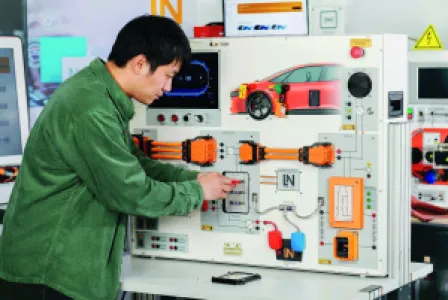
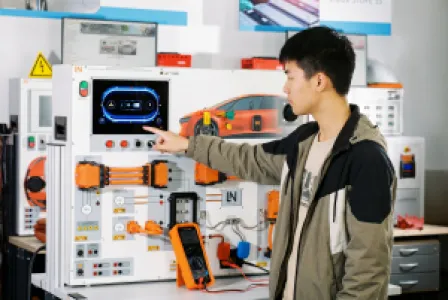
The CarTrain “Diagnosis and Repair of High Voltage Vehicles” brings real workshop processes into technical training. Learners diagnose faults, perform measurements, replace defective components and carry out high voltage procedures using real, vehicle-related components.
Following the principles of Real Experience Learning, the training system combines practical workshop tasks with structured learning processes. More than 25 practice-oriented projects in RXLea guide learners step by step through realistic diagnostic and repair tasks and provide automated feedback.
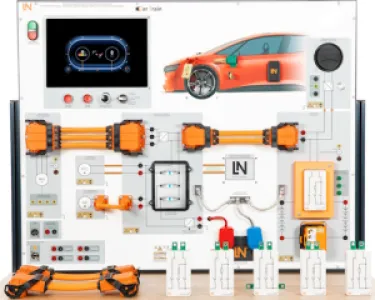
Learners work with a complete, fully functional high voltage system and perform real measurements at a system voltage of 400 V in a controlled training environment. They practise common high voltage disconnection procedures, insulation and potential equalisation measurements, fault diagnosis and the replacement of defective components.
An integrated OBD diagnostic scan tool enables learners to read fault codes, analyse live data and work through guided diagnostic procedures. Different drive configurations and precharge concepts help them understand how high voltage systems operate across different vehicle architectures.
Real vehicle components, interchangeable relays, high voltage fuses, service disconnects, inverter, electric motor and charging components create realistic workshop scenarios. Learners can remove, diagnose and replace components and develop a clear understanding of how the complete high voltage system works together.
The manufacturer-independent concept supports the transfer of acquired knowledge to different electric and hybrid vehicle systems.
CarTrain combines practical relevance, system understanding and safe hands-on experience to develop the technical competence required for diagnosis and repair of modern high voltage vehicles.
Industrial Mechatronic Unit (IMU) – From PLC Programming to Connected Production
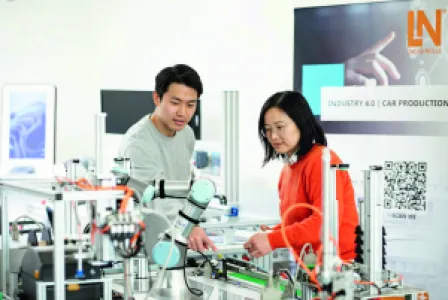
The Industrial Mechatronic Unit (IMU) enables learners to build practical skills in industrial automation step by step. From the fundamentals of PLC programming to connected production processes, the modular system provides a flexible environment for practice-oriented mechatronics training.
Learners work with industrial components and experience how sensors, actuators, controllers and communication technologies interact in an automated production process. Additional modules can be integrated to expand the system as training requirements develop.
Operate, Monitor and Understand Industrial Processes
An industrial touch panel and configurable control elements allow learners to operate the system and monitor its status. The programmable touch panel can display process information and supports the practical understanding of machine operation and process control.
The IMU includes a programmable logic controller (PLC), Ethernet communication interfaces, a DC motor and various sensors. An IO-Link master enables the integration of smart sensors, including an RFID read/write head. The PLC inputs and outputs can also be connected to additional processing stations.
From Individual Processes to Connected Production
After learning the fundamentals of PLC programming, learners can expand their knowledge through practical production processes. These can include separating, processing, quality control, labeling and sorting of workpieces.
Several units can be networked to create more complex production environments. This allows learners to explore connected automation and the interaction between individual production processes. Where required, higher-level systems such as ERP can also be integrated.
Working with industrial components and realistic production processes helps learners transfer theoretical knowledge directly into practical skills and prepares them for real tasks in industrial automation.
This is Real Experience Learning.
UniTrain – compact, guided and practice-oriented learning
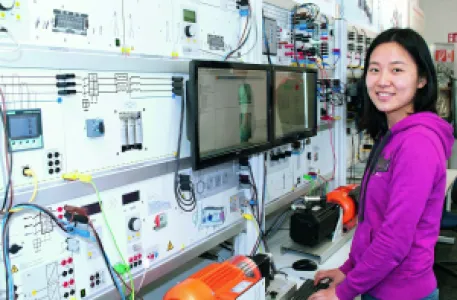
UniTrain is a compact training system for practical learning in electrical engineering and electronics. It combines real hardware, practical experiments and multimedia learning content in structured courses.
Learners apply theoretical knowledge directly in experiments, measure real signals and evaluate their results step by step. This creates a direct connection between theory and practice – in line with Real Experience Learning.
A complete learning environment in a compact format
UniTrain combines the interface, experiment hardware and digital learning content in one coordinated training concept. The system supports guided laboratory exercises as well as self-directed learning.
Virtual measuring instruments, voltage sources and analog and digital inputs and outputs are available through the UniTrain interface. Learners work with real measured values in a safe low-voltage environment.
Practical learning with direct feedback
The UniTrain interface records and processes the measured values from the experiments. Learners analyse the results within the course, compare them with the expected behaviour and develop a clear understanding of electrical and electronic relationships.
Structured tasks and integrated fault-finding functions support systematic learning and help learners build practical technical competence step by step.
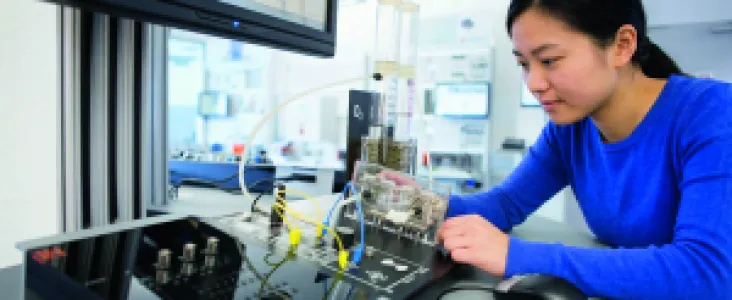
Photovoltaic Hybrid System with Battery – Understand Energy Flows, Commission Systems and Operate Them Safely
With the Photovoltaic Hybrid System with Battery, learners develop practical skills for planning, commissioning and operating modern photovoltaic hybrid systems. They investigate the interaction between photovoltaic generation, battery storage, the grid and loads, and learn how to handle different operating modes safely.
The integrated solar array emulation enables weather-independent and reproducible experiments. Learners investigate different irradiation conditions, solar profiles and partial shading and directly observe how these factors affect energy generation and system behaviour.
From System Understanding to Practical Application
An industrial hybrid inverter is at the heart of the system. Learners configure the device for different application scenarios, including self-consumption optimisation, stand-alone operation and uninterruptible power supply. By working with real industrial components, they apply theoretical knowledge directly to typical tasks in energy technology.
Using the SCADA software for PowerLab, learners record and visualise energy flows, voltages, currents and device states. They analyse charging characteristics, efficiencies and dynamic processes and systematically evaluate deviations. This makes complex interactions between the solar array, battery storage, grid and loads clearly understandable.
Dimension, Measure and Evaluate in Practice
In addition to commissioning, learners learn how to dimension stand-alone photovoltaic systems based on defined load profiles. They determine suitable sizes for the PV generator and battery storage, linking the physical principles of solar energy with practical planning tasks.
Real measuring instruments, safe connections and the clearly structured PanelTrain environment support a transparent learning process. Step by step, learners develop the practical competence to plan, configure, analyse and commission photovoltaic hybrid systems.
This is Real Experience Learning: understanding complex energy systems by experiencing, measuring and applying them in practice.
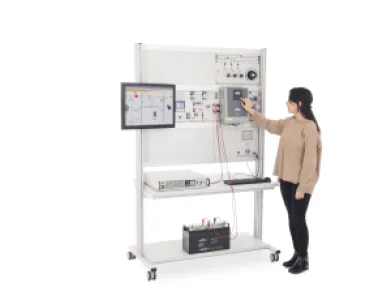
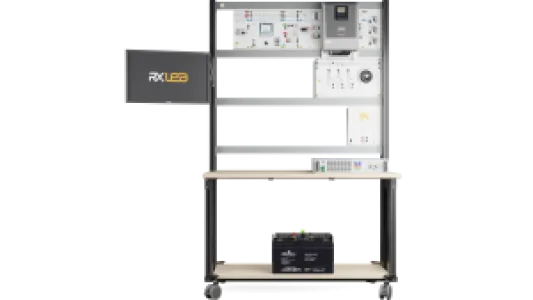
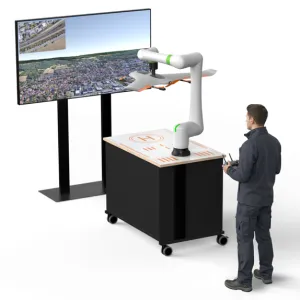
Unmanned Aerial Vehicles (UAVs) – Understand, configure and systematically diagnose UAV systems
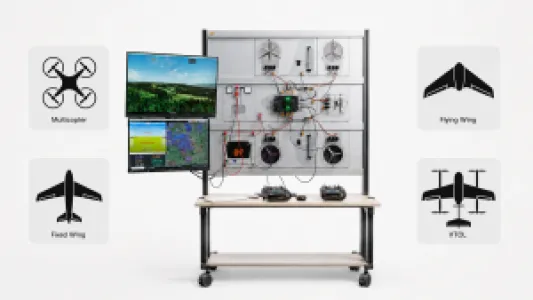
With the PanelTrain for unmanned aerial vehicles, learners develop practical skills for the setup, configuration and diagnosis of modern UAV systems. All essential subsystems are clearly arranged on one training wall. This makes signal paths, wiring and the interaction of individual components visible and easy to understand.
The training follows the principle of complete action. Learners work on practice-oriented assignments using real UAV components. They wire the system, calibrate sensors, configure actuators and the remote control, and systematically analyse faults. Six consecutive learning projects guide the competence-building process step by step.
From Individual Components to a Complete UAV System
The training wall combines a flight controller, ESCs, brushless motors, GPS/GNSS, sensors, telemetry, power distribution and remote control in a clearly structured learning environment. Learners understand the function of each component and how they work together as a complete UAV system.
Four different UAV configurations can be explored using the same hardware: quadcopter, fixed wing, flying wing and VTOL. The differences are created through software configuration. Learners can configure, test and compare the different platform concepts.
Configure, Calibrate and Control
For configuration and diagnostics, learners work with ArduPilot and Mission Planner or QGroundControl. They calibrate the IMU, compass and barometer, assess GPS signals and commission the system step by step.
Using the RadioMaster TX16S and EdgeTX, they configure control channels, flight modes and safety functions. This turns theoretical system knowledge into practical competence.
Identify Faults and Make Informed Decisions
Training does not end with commissioning. Learners perform readiness checks, carry out electrical measurements, analyse log files and troubleshoot software-related faults. In this way, they develop a structured approach to diagnostics and maintenance and learn how to assess the technical condition of a UAV system.
This is Real Experience Learning: understanding complex UAV technology by building, configuring, testing and diagnosing real systems.